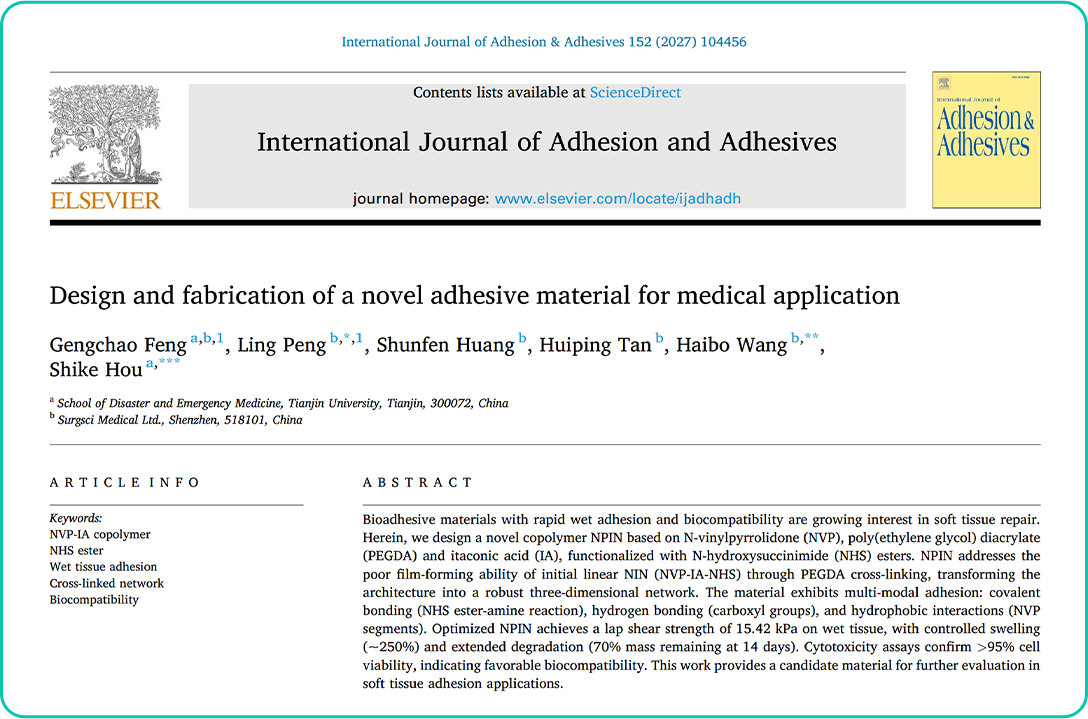
Surgsci has made new progress in the development of medical adhesive materials for wet tissue environments. The research, published under the title Design and fabrication of a novel adhesive material for medical application, presents a newly developed crosslinked terpolymer adhesive known as NPIN.
The study focuses on a practical challenge in soft tissue repair: achieving stable adhesion in surgical environments where blood and tissue fluids are often present. Beyond introducing a new material formulation, the research provides a potential technical foundation for future medical devices such as surgical sealing films and tissue reinforcement patches.
Why Wet Tissue Adhesion Matters
During surgery, tissue surfaces are rarely completely dry. Blood and tissue fluids can interfere with the performance of hemostatic and adhesive materials, often requiring the target area to be wiped or dried before application. Even then, maintaining reliable contact on soft, fragile or continuously moving tissue can be difficult.
Sutures, staples and surgical clips remain essential methods of tissue closure. However, in certain situations, mechanical closure alone may not fully address the need for tissue approximation, fluid sealing, air sealing or local hemostatic support.
Medical adhesives may therefore serve as a valuable complement to conventional closure techniques. Their development requires more than strong adhesion: the material must also balance flexibility, swelling, degradation, structural stability and biocompatibility.
From a Linear Polymer to a 3D Network
The research team initially developed a linear copolymer called NIN. Although its functional groups could react with proteins on the tissue surface, the material showed limited mechanical strength and film-forming ability, making it difficult to produce a stable, self-supporting film.
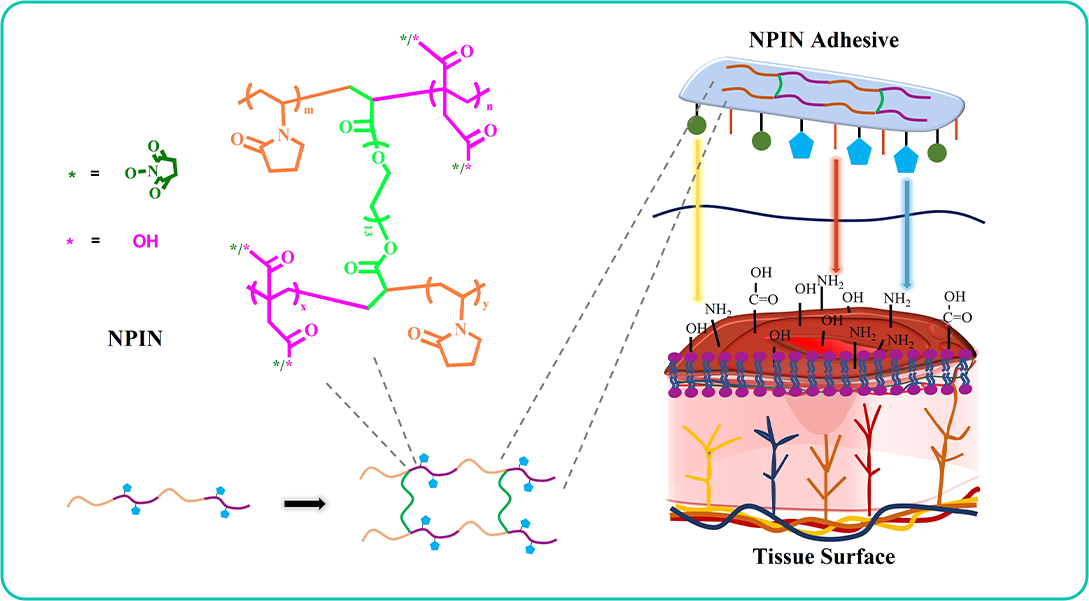
To address this limitation, polyethylene glycol diacrylate (PEGDA) was introduced as a flexible crosslinker. This transformed the original linear polymer structure into a three-dimensional crosslinked network, creating the new NPIN material.
The structural redesign improved the material’s integrity, flexibility and film-forming performance. The optimized NPIN could form a transparent, flexible, self-supporting film approximately 50 μm thick, providing an important basis for further exploration of film-based medical devices.
Based on its chemical composition, the researchers proposed that NPIN may establish adhesion through a combination of covalent bonding, hydrogen bonding and hydrophobic interactions. These mechanisms may work together to support initial tissue contact, displace interfacial water and stabilize the adhesive interface. Further direct studies will be required to determine the contribution of each mechanism.
Key Performance Findings
In lap-shear testing on wet porcine skin, the optimized NPIN achieved an adhesive strength of 15.42 ± 1.44 kPa, approximately three times that of the initial NIN material. The result indicates that the three-dimensional network improved both film integrity and wet tissue adhesion performance.
In phosphate-buffered saline at 37°C, NPIN gradually transitioned into a hydrogel-like state and reached an equilibrium swelling level of approximately 250% after two days. Controlled swelling may help the material conform to tissue surfaces, while avoiding excessive expansion that could place pressure on surrounding tissue.
The material also demonstrated a relatively gradual degradation profile, retaining approximately 70% of its initial mass after 14 days in vitro. This suggests the potential to maintain structural integrity during the early stage of tissue repair, although in vivo studies are still required.
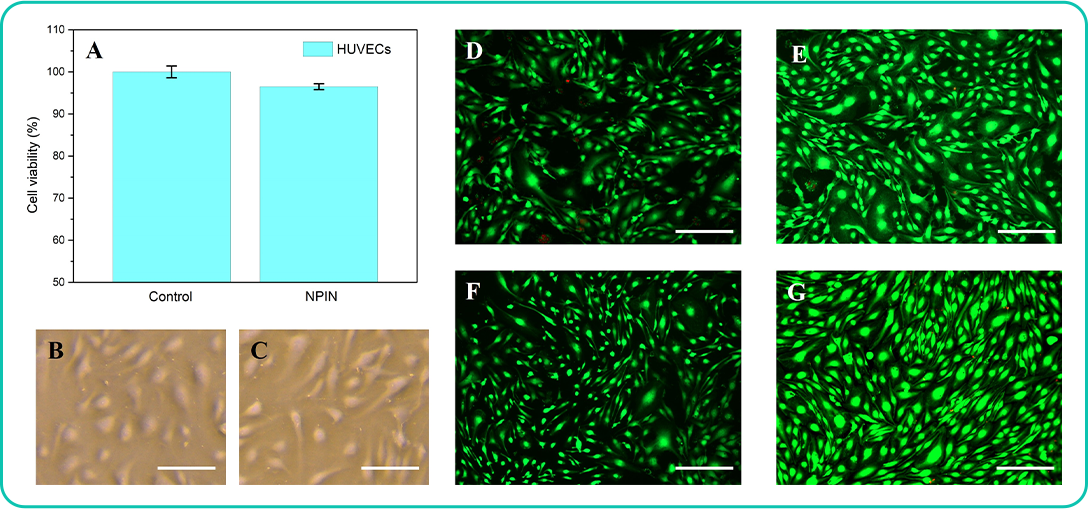
Initial cytocompatibility testing showed that human umbilical vein endothelial cells maintained a viability rate of more than 95% after 24 hours of exposure to NPIN extract. The cells also retained normal attachment and spreading morphology during observation.
Potential Significance for Medical Device Development
The value of this research extends beyond a single polymer formulation. NPIN combines wet tissue adhesion with self-supporting film formation, transparency, flexibility and adjustable swelling behaviour. Its single-layer crosslinked network also distributes adhesive functional groups throughout the material, giving both sides of the film potential tissue-reactive properties.
With further validation, this technology could be explored for applications such as biodegradable surgical sealing films, hemostatic sealing patches and tissue reinforcement patches. It may also be studied in combination with dedicated applicators, minimally invasive delivery devices or stapling systems to support controlled placement in different surgical settings.
If future safety and effectiveness studies are successful, related products may offer surgeons an additional option alongside sutures, staples and surgical clips when treating soft or fragile tissue. Their intended clinical value would be to support tissue approximation and sealing while potentially reducing additional puncture or compression of the tissue. These potential benefits have not yet been clinically established and remain objectives for further research.
Further Validation and Application Exploration
NPIN remains a candidate material at the research stage. The study has completed material synthesis, structural characterization, ex vivo wet tissue adhesion testing, in vitro degradation evaluation and preliminary cytocompatibility assessment.
Further work will focus on its performance under conditions that more closely resemble real surgical environments, including dynamic tissue surfaces and the presence of blood. In vivo degradation, tissue response, sterilization, storage stability, packaging, transportation and compatibility with delivery devices will also require systematic evaluation.
From a linear polymer to a three-dimensional network, this research represents an important step in Surgsci’s continued exploration of medical materials for minimally invasive surgery and tissue repair.
Surgsci will continue connecting material science, product engineering and clinical needs to advance meaningful medical innovation and fulfil its mission of improving human health and quality of life.
Publication Title: Design and fabrication of a novel adhesive material for medical application
Journal: International Journal of Adhesion and Adhesives
DOI: 10.1016/j.ijadhadh.2026.104456
Article Link: https://www.sciencedirect.com/science/article/abs/pii/S0143749626001983